Bielefeld – eine PVC-freie Zone? (1986)
Lahl U. (1986): Bielefeld – eine PVC-freie Zone? In: Dokumentation des PVC-Hearings “Gefährden PVC-Produkte die Umwelt?” 22.10.1986, Hrsg.: Stadt Bielefeld, S. 4-5


Lahl U. (1986): Bielefeld – eine PVC-freie Zone? In: Dokumentation des PVC-Hearings “Gefährden PVC-Produkte die Umwelt?” 22.10.1986, Hrsg.: Stadt Bielefeld, S. 4-5
April 30, 2024
The contractors were N3 Nachhaltigkeitsberatung Dr. Friege & Partner, Voerde (project management), and the Collaborating Centre on Sustainable Consumption and Production (CSCP), Wuppertal, as well as BZL GmbH and Akademie Dr. Obladen, Berlin, as subcontractors. The final report on the project was published on the Federal Environment Agency’s website at the end of April 2024:
Friege H., Heidbüchel E., Zeschmar-Lahl B.: Indicators for sustainable management of chemicals. Contributions to upcoming development work under the new Global Framework for Chemicals. Ed.: Umweltbundesamt.
Friege H., Heidbüchel E., Zeschmar-Lahl B.: Indicators for sustainable management of chemicals. Contributions to upcoming development work under the new Global Framework for Chemicals. Ed.: Umweltbundesamt. UBA-Texte 78/2024
Lahl U., Lechtenberg D., Zeschmar-Lahl B. (2024): Kunststoffrecycling und gefährliche Stoffe – RISK CYCLE. (Plastics recycling and hazardous substances – RISK CYCLE). Müll und Abfall 4, 195–204
Article (in German) based on the first publication in Abfallwirtschaft und Energie 1 ( 2024)

April 19, 2024
The updated article by Prof. Dr. habil. Uwe Lahl and his two co-authors on the topic of “Plastics recycling and hazardous substances – risk cycle” has been published in the journal Müll und Abfall 4, 2024.
The production of new plastic articles has become increasingly demanding in terms of polymers and additive formulations. Can the recycling of mixed packaging plastics even meet today’s requirements for new products? We believe this is illusory. An honest assessment of the performance of post-consumer (PC) recycling of plastic packaging (packaging sold vs. recyclates in new products) for Germany shows: The result of quantitative material recycling is rather meager (perhaps 20%) and the recycled products are of inferior quality. Due to the overwhelming amount of data on hazardous substances (“legacy additives”) in plastic recyclates, we recommend that they no longer be used in consumer-related products (children’s toys, food contact materials/packaging, interior products, textiles, etc.).
Below you will find a link to the order form at Erich Schmidt Verlag.
Lahl, U. (2023): Riskcycling – was mich mit Martin Führ verbindet. In: Julian Schenten, Bettina Brohmann, Rebecca Niebler (Hrsg.): Menschen und Moleküle in der Transformation – Festschrift für Martin Führ, sofia Berichte 2023, S. 64-65


Quelle: Dma wb, CC BY-SA 4.0, via Wikimedia Commons
March 25, 2024
We have been advising Wienerberger AG on the further development of its sustainability management for several years. This includes scientific advice on the preparation of the report on non-financial performance in accordance with the Sustainability and Diversity Improvement Act (NaDiVeG) and sustainability reporting in accordance with the GRI standard; this was also the case for the combined Annual and Sustainability Report 2023, which has been available for download on Wienerberger’s website since March 25, 2024.
Lahl, U. (2023): Chemische Energien. In: Hermann, W. (Hrsg.): Antriebswende. Strategien, Positionen und Meinungen zur neuen Mobilität. Molino-Verlag, 53-82 (only in German)
Leider hat sich im Text auf Seite 71 der Fehlerteufel eingeschlichen. Im „Fazit Effizienz“ muss es heißen:
Die Flächeneffizienz ist ein „pro“ für das ICE. Hingegen ist die Antriebseffizienz das zentrale »pro«, was für das BEV spricht.
Abkürzungen:
ICE = Internal Combustion Engine (Pkw mit Verbrennungsmotor)
BEV = Battery Electric Vehicle (Elektroauto mit Batterie)
February 8, 2024
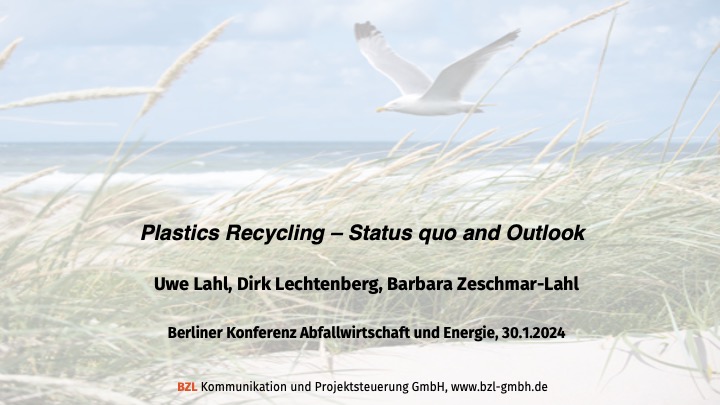
The article by Prof. Dr. habil. Uwe Lahl and his two co-authors on the subject of “Plastics recycling and hazardous substances – Risk Cycle” (in German: Kunststoffrecycling und gefährliche Stoffe – Risk Cycle) has been published in the proceedings of the Berlin Conference on Waste Management and Energy – “Abfallwirtschaft und Energie 1” – by TK-Verlag.
Referring to current studies and scientific publications, the authors argue that the use of post-consumer recyclates (from packaging or technical products) for the manufacture of products with direct contact to humans should be discontinued for the time being. This applies in particular to children’s toys, food contact material (FCM)/packaging, indoor products and synthetic fibers.
Packaging should rather be collected unmixed in a controlled manner via extended deposit and return systems and sent for high-quality material recycling (closed loop, same product types such as PET bottles to PET bottles, PET trays to PET trays).
In the medium term, the existing separate collection of lightweight packaging could be converted into a dry collection of recyclable materials, for example to include plastics that were previously not recyclable or difficult to recycle (e.g. technical plastic products) and make them available for chemical recycling.
Below you will find a link to order the conference proceedings and to download the presentation at the conference in German and English.
Lahl U., Lechtenberg, D., Zeschmar-Lahl B.: Kunststoffrecycling und gefährliche Stoffe – RISK CYCLE. In: Thiel S., Thomé-Kozmiensky E., Quicker P., Gosten A., Stengler E. (Hrsg.): Abfallwirtschaft und Energie 1, 458-480, 2024